Finding product-market fit in an emerging wearables category
Wearable Tech | Market Research | Product Strategy | Diary Study | User Interviews
BACKGROUND + OBJECTIVE
Understanding consumer appetite for smart glasses in an emerging wearables market
PROBLEM
Meta was preparing to enter the smart glasses category through a new partnership with Ray-Ban, but the market was still nascent and consumer appetite was unclear. Our clients came to us to understand how people were adopting existing wearable technology, where current products were falling short, and what Meta would need to get right to create a product consumers would actually integrate into their lives.
OBJECTIVES
-
Assess the current state of the wearable tech market.
-
Understand user tech ecosystems, usage behaviors and brand perceptions in the wearables space.
-
Evaluate user journey from out-of-box experience to lifestyle adoption.
-
Identify potential barriers to market entry and cause for product abandonment.
-
Translate consumer needs and market gaps into recommendations for product positioning, experience principles, and feature priorities.
APPROACH
Using existing wearable products to understand the expectations for a category that hadn't yet found its footing
We designed a three-phase study that moved from understanding the broader wearables landscape to observing how existing products performed in people's everyday lives. Rather than creating a feature-by-feature scorecard, we looked across products, contexts, and behaviors to identify the underlying conditions that determined whether wearable technology was adopted or abandoned.

Key Questions
What determines whether wearable technology earns a lasting place in someone's life?
BEHAVIORAL
What are users doing?
What tasks are users trying to complete?
In what settings and scenarios are they using the device?
Research Themes
Trust & Transparency
Form Factor
EXPERIENTIAL
How is the device performing?
How is it performing on each task?
How does environment or setting affect the completion of the task?
How does the use of the device impact the user?
Error Recovery
Discoverability
Evironmental & Ambient Dynamics
OPPORTUNITY
How can we build a product that succeeds in this space?
Where do other devices succeed?
What is left to be desired for consumers?
What features or capabilities drive adoption?
OUTCOME
Turning an uncertain market into a clearer product strategy
Our research gave Meta a clearer picture of the conditions smart glasses would need to meet to move beyond novelty and become part of consumers' everyday lives. We translated findings across existing wearable products into three strategic principles for the emerging experience: form, function, and trust.
The research helped inform product priorities around discreet, familiar form factors; flexible lens options; reliable capture and voice interactions; and transparency around privacy and device behavior.
Most importantly, it reframed the opportunity from building a piece of wearable technology to creating something consumers could comfortably wear, use, and trust as part of everyday life.
FORM
Wearables needed to look like something people already wanted to wear.
Participants were sensitive to bulky or conspicuously technological designs, making aesthetics part of the adoption equation rather than a secondary consideration.
Design implication: Create a lightweight, familiar form that can blend into consumers' existing style and routines.
A device worn throughout the day can't be limited to a narrow set of environments.
Sunglass-specific lenses are limiting and confine users to a select few use cases.
Design implication: Offer a range of blue-lens, prescription, and polarized colorways to maximize adoption.


FUNCTION
Smart interactions have to feel more reliable than the friction they replace.
Without a visual interface, users relied heavily on voice commands and audible feedback to understand whether the device had heard them and completed an action. Failed or ambiguous interactions quickly undermined confidence in the technology.
Design implication: Make voice interactions predictable and transparent through clear commands, immediate audible feedback, and well-defined expectations for what the assistant can and cannot do.
Convenience loses its value when quality or speed requires compromise.
Low-resolution photos, recordings, and delayed voice commands diminished the perceived value of having an always-available camera. Users expected wearable technology to make capturing a moment easier, not introduce new friction or sacrifice quality.
Design implication: Prioritize capture quality and responsiveness, while providing a manual trigger that gives users a faster, more dependable way to capture moments in real time.
TRUST & TRANSPARENCY
For technology worn on the body, trust extends beyond the person wearing it.
Smart glasses introduced privacy concerns that weren't limited to users themselves. Participants needed to understand when the device was active, what information it captured, and how it might affect people around them.
Product implication: Make the device's capabilities and limitations legible, provide clear signals when capture features are active, and use trusted partnerships to help bridge the gap between unfamiliar technology and familiar consumer products.
APPENDIX
Participants
Mental Models Survey: N = 500+
5-week Diary Study: N=75
-
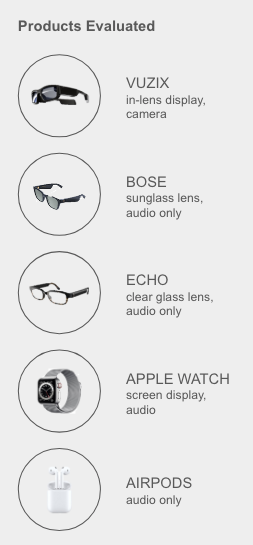
Vuzix glasses n=11*
-
Bose glasses n=19
-
Echo glasses n=3**
-
Apple watch n=21
-
Airpods n=21
Study participants were recruited to represent a mix of:
-
Geography (across the US)
-
Age (18-55)
-
Gender (skewed slightly female)
-
Ethnicity
-
Tech Savviness
Sample size includes only those who completed the full study, does not account for drop-offs
* 4 Vuzix participants dropped out of the study because the product made them feel ill
** Low sample due to limited product availability
Our Team
-
Account Director
-
Creative Director
-
2 UX Researchers
-
Data Scientist
-
Research Ops Associate
My Role
-
Learning design
-
Moderation
-
Qual Analysis
-
Client delivery
-
The Directors provided account leadership, vision, scope and resourcing.
-
Data scientist analyzed survey data